



Choosing between Cambridge English exams and IELTS can be confusing, especially since both are widely recognised but work in very different ways. In this guide, we’ll break down the key differences so you can decide which English test best suits your goals, whether you’re studying, working, or moving abroad.
What are Cambridge English exams?
Cambridge English exams are level-based qualifications (A2, B2, C1, C2, etc.). Each exam corresponds to a specific CEFR level, and once you pass, you receive a certificate that is valid for life.
- Key idea: You prove that you have reached a specific English level, and that qualification never expires.
- Important: If you enter a higher-level exam (for example, C1 Advanced) but do not achieve a pass, you may still receive a certificate for the lower level you demonstrated (e.g. B2 First). Similarly, strong performance above the pass threshold can sometimes result in recognition at a higher level.
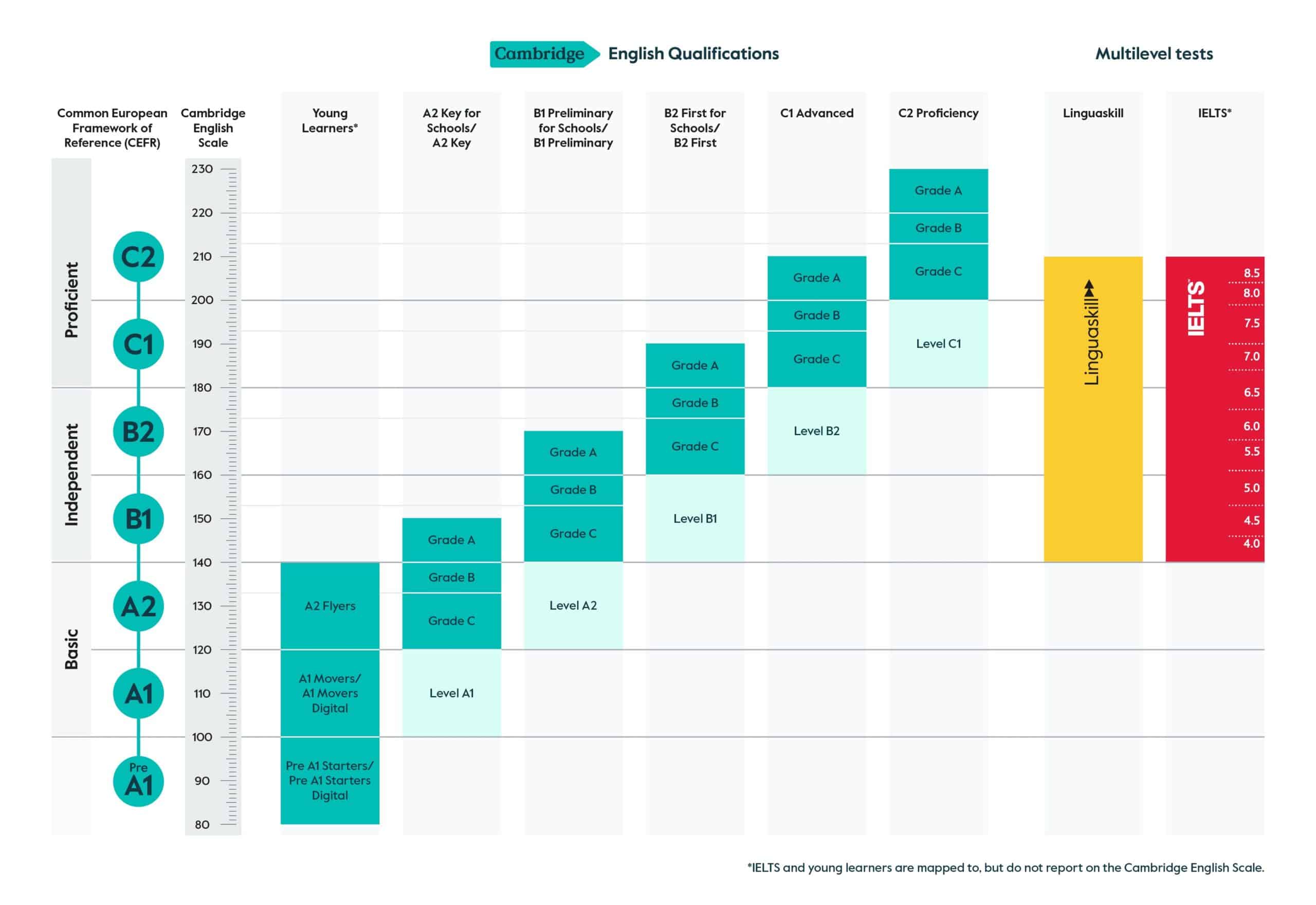
Image source: https://support.cambridgeenglish.org/hc/en-gb/articles/202839876-Extended-Certification
What is IELTS?
IELTS works differently. Instead of passing a level, you receive a band score from 0 to 9.
- Key idea: It reflects your current English level at a specific point in time.
- Important: IELTS results are valid for 2 years only.
Cambridge vs IELTS: Key differences
Validity
- Cambridge: lifetime certificate
- IELTS: valid for 2 years
If you do not want to retake an exam later, Cambridge may be more convenient.
Types of exams
- Cambridge: Young Learners (Pre A1–A2), A2 Key for Schools and A2 Key, B1 Preliminary for Schools and B1 Preliminary, B2 First for Schools and B2 First, C1 Advanced, C2 Proficiency
- IELTS: Academic, General Training or UKVI (UK Visas and Immigration)
Cambridge offers multiple level-based exams, while IELTS has three main test types depending on your goal.
Scoring system
- Cambridge: pass/fail with grade (A, B, C)
- IELTS: band score (e.g. 6.5, 7.0, 8.0)
IELTS provides more detailed scoring, while Cambridge is more milestone-based.
Recognition
- Cambridge: highly respected, especially in Europe
- IELTS: widely accepted worldwide
IELTS is often required for visas and international university admissions.
Speaking test
- Cambridge: usually a paired speaking test with another candidate or a dummy partner
- IELTS: face-to-face interview with an examiner
Your preference may depend on which format feels more comfortable.
Results
- Cambridge: slower results (several weeks)
- IELTS: fast results (usually within a few days)
IELTS is better if you need a quick certification.
Which one should YOU choose?
Choose Cambridge if:
- You want a certificate that never expires
- You are focused on long-term goals (CV, career progression)
- You prefer clear level milestones
Choose IELTS if:
- You want to study or move abroad soon
- You need it for visa or immigration purposes
- You want fast results
Final thoughts
There is no “better” exam; it depends on your goals.
IELTS = flexible, fast, globally recognised
Cambridge = stable, long-term, level-based
If you already have a clear plan (studying abroad, work, or relocation), that should guide your choice.
inlingua Malta offers a range of exam preparation courses alongside a 30- or 40-week Academic English Foundation Year Programme designed to take students from A1 or B1 level up to C1 level, helping them prepare for university entry. The programme includes structured English classes, an exam preparation course, and the Cambridge or IELTS exam of the student’s choice, all included in the price.

For more information about our services, contact the inlingua Malta team at info@inlinguamalta.com